

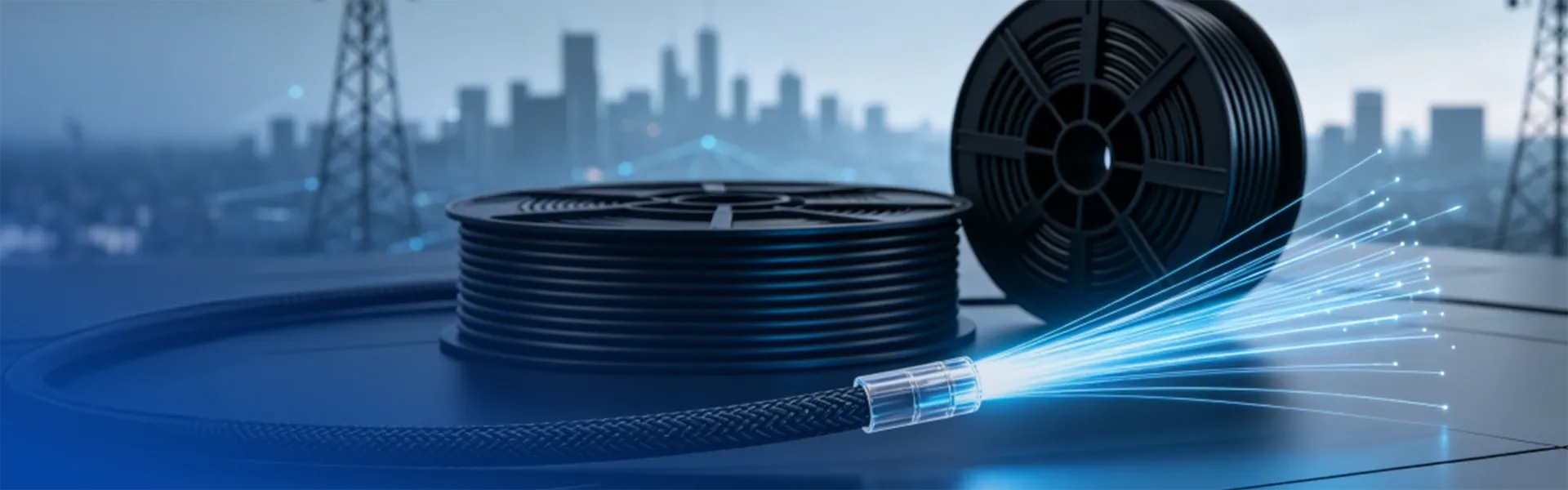
Direct buried and underground fiber optic cable from Huifiber: SWA armoured constructions for highway, tunnel and sewer installation, with rodent protection.
Direct buried fibre cable is designed to be placed in a trench and backfilled, with no duct or conduit around it. It removes the cost of ducting and the labour of duct pulling, but only if the cable's mechanical and moisture protection are specified correctly for the soil and the traffic load above it.
A warning tape laid 300 mm above the cable is inexpensive insurance against future excavation damage and is mandatory in many jurisdictions.
Direct burial wins where the route is long, straight and stable: rural backhaul, campus links, wind farm collector networks, pipeline monitoring routes and border or perimeter links. Duct wins where future expansion, frequent access or high traffic loading is expected, and in urban areas where the route will be shared with other utilities.
The trench has barely been closed before the cable is out of sight for the next twenty-five years, so testing must be thorough. Run an OTDR trace on every fibre before backfill — while a fault can still be repaired by hand — and again after backfill to confirm nothing moved. Record both traces as the acceptance baseline. Measure end-to-end insertion loss against the calculated budget, and verify continuity on every core against the labelling record. Any fibre that fails should be repaired immediately; retro-excavation costs many times more than a splice made at the time.
Huifiber supplies direct buried cable from 2 to 288 cores with steel tape, steel wire or dielectric armouring. Tell us the soil type, burial depth, expected traffic load and whether the route must be non-metallic, and we will specify the right construction and armouring grade.
Direct buried cable has to work without a duct, so armour, water blocking and crush resistance carry the whole load of protecting the fibers for decades.
Direct burial requires an armored cable with a steel tape and full water blocking, because the cable is in permanent contact with soil and cannot be replaced easily. If you are installing duct anyway, a lighter unarmoured or single-armour cable such as GYTA is usually cheaper and easier to pull.
Work through four questions: what is the soil type and burial depth, is there rodent or termite risk, what is the water table, and what tensile load will the pull put on the cable. Those four answers decide the armour type, the sheath compound and the strength member.
Yes. Corrugated steel tape is the primary defence, and we can add glass yarn or nylon layers for installations where rodents are a known problem.
As a rule of thumb, plan for a minimum bend radius of about 20 times the cable diameter under load and 10 times when static, and never exceed the short-term tensile rating on the datasheet. For long pulls we recommend pulling through a duct or using a winch with a load cell.
We offer both gel-filled and dry-core water-blocked designs. Dry-core cable is preferred where cleaning and splicing speed matter, while gel-filled cable remains the traditional choice for harsh wet environments.
Still have a question? Send us your specification and our engineers will reply with a recommendation and a quotation.