

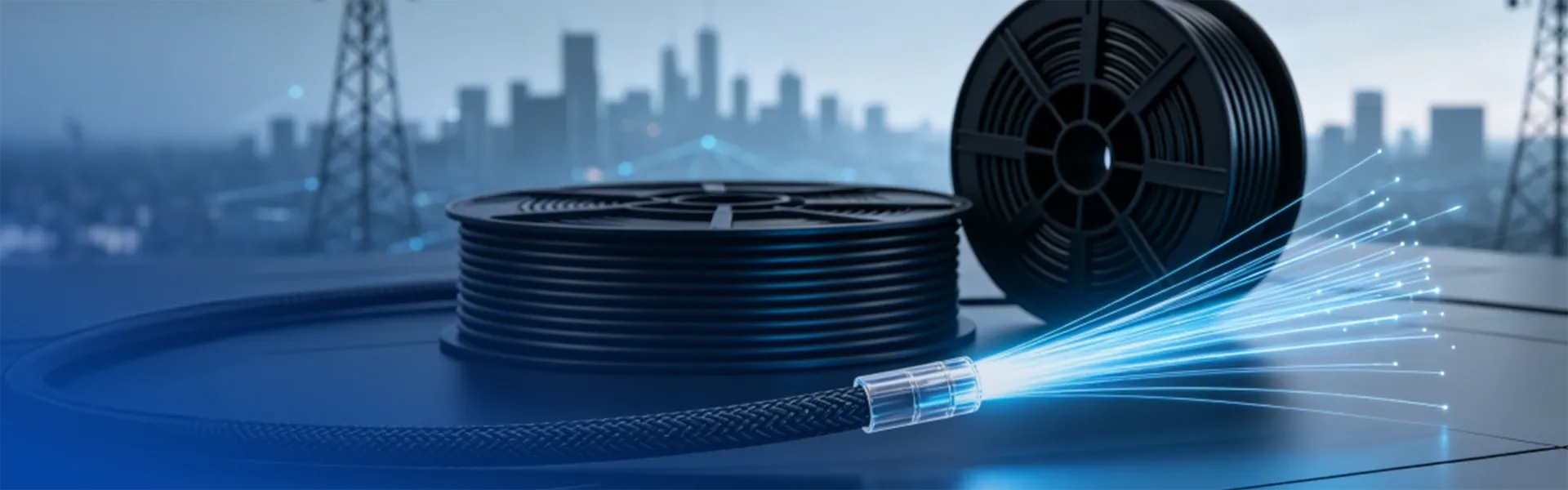
Figure 8 aerial self-supporting drop cable from Huifiber: GYTC8S types with integrated messenger wire for aerial FTTH deployment, 2-24 cores, G.652D fiber.
A figure-8 aerial cable integrates the optical unit and the steel messenger wire into a single cable with an 8-shaped cross section. The messenger carries the mechanical load and the optical unit hangs below it on a thin web, so the installation needs no separate lashing wire and no separate tensioning hardware.
The upper lobe is a stranded galvanised steel messenger or a dielectric FRP rod. The lower lobe holds the loose tube or tight-buffered fibres. A thin connecting web keeps the two lobes aligned during paying out and allows a single clamp to grip both.
Standard figure-8 drop cable covers spans of 50-100 m comfortably. Reinforced versions with a larger messenger reach 150 m and beyond. The installation tension should be set so the everyday tension stays below roughly 20% of the messenger's rated breaking load, with sag calculated for the worst combined wind and ice case.
Clamping is critical: the clamp must grip the messenger lobe, never the optical lobe. Gripping the optical unit transfers the full span load into the fibre tube and causes gradual, invisible attenuation growth.
Choose bow-type drop cable for spans under about 50 m on the subscriber drop. Choose figure-8 aerial cable for distribution spans of 50-150 m along the pole line. Choose ADSS when the route follows a high-voltage power line and no metallic component is permitted.
Where a steel messenger is used, the messenger should be bonded to the pole ground at each pole so that a lightning strike or a contact with a fallen conductor is diverted to earth rather than travelling into the subscriber premises. The optical unit itself carries no current, so the fibre and the electronics are never exposed — the bonding exists to protect the messenger and the pole hardware. On routes where even that is unacceptable, the all-dielectric FRP messenger version removes the metallic path completely.
Newly strung figure-8 cable takes time to reach its final sag, because the messenger settles into its creep curve under sustained tension. Inspect the span again after roughly two weeks and re-tension if the sag has grown beyond the design value. Leaving an under-tensioned span in place is a common cause of mid-span contact with tree branches and of oscillation damage in high wind.
Huifiber supplies figure-8 aerial cable in 2 to 24 cores, with steel or FRP messenger, PE or LSZH sheath, and on request with factory-fitted connectors or pre-installed drop closures. Send us the pole spacing, wind and ice loading and core count and we will confirm the messenger grade and recommended sag.
Figure-8 aerial cable combines the fiber unit and its messenger wire in a single cross-section, giving a stronger self-supporting drop for longer spans.
It is a cable whose cross-section looks like the number eight: the optical unit sits in one loop and the messenger wire sits in the other, joined by a common jacket that can be split during installation. The messenger carries the mechanical load so the fiber stays strain free.
For typical drop applications it works from about 50 m up to 150 m, while heavier feeder constructions reach longer. The final span depends on the sag and load calculation for your poles and local wind and ice conditions.
The messenger is normally galvanised steel strand, sized to the span and load case. An all-dielectric version is available where bonding and grounding must be avoided.
Figure-8 cable handles longer spans and higher wind and ice loads, and the separate messenger makes tensioning straightforward. Bow-type remains cheaper and faster for short facade drops.
Yes, figure-8 cable can be delivered with SC or LC connectors fitted and cut to the exact span length you need.
Still have a question? Send us your specification and our engineers will reply with a recommendation and a quotation.