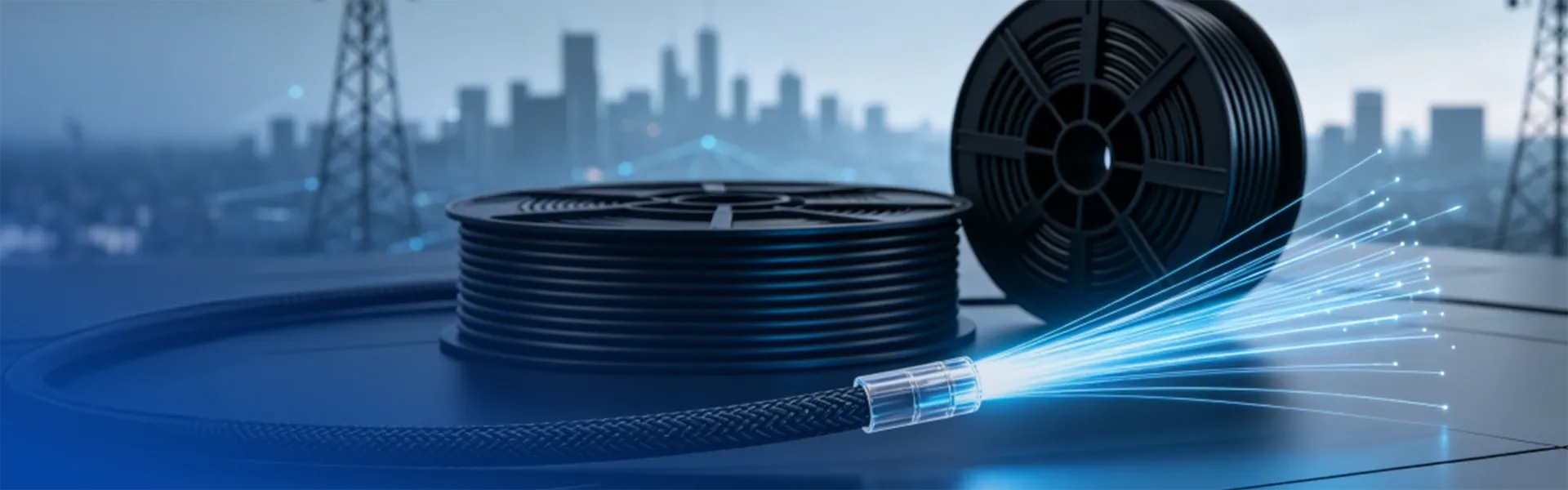
ADSS (All-Dielectric Self-Supporting) cable is the standard choice for aerial fibre routes that run along high-voltage transmission lines. Because it contains no metal, it can be installed inside the high-potential zone of a power tower without a separate grounding system and without any risk of induced current reaching the network equipment.
A conventional aerial cable with a steel messenger wire must be grounded at every pole, which adds cost and creates a conductive path into the substation. ADSS removes that requirement entirely: the aramid yarn strength members carry the mechanical load while remaining electrically invisible to the phase conductors below.
The single most important selection decision for ADSS is the outer sheath. Two options dominate:
Choosing incorrectly is the most common cause of premature ADSS failure. The field strength at the attachment point — not the nominal line voltage — is what determines the sheath, and it depends on the tower geometry, the phase spacing and where on the crossarm the cable is mounted.
ADSS is installed under controlled tension, and the sag must be calculated for the worst-case combined load: wind plus ice plus the cable's own weight. Recommended practice is to keep the maximum working tension below 20-25% of the cable's rated tensile strength (RTS), and the everyday tension below 16-20% of RTS, so the cable retains margin against creep over its 25-year design life.
Typical spans run 100-200 m. Longer spans are possible but reduce the safety margin and may require a higher-grade aramid yarn construction. The installation point on the tower also matters: mounting further from the phase conductors lowers the field strength and can allow a cheaper PE sheath.
ADSS is also preferred for routes crossing rivers, ravines and railways where trenching is impractical, and for wind farms where the collector network follows the turbine access roads.
Huifiber manufactures ADSS cable in PE and AT sheath grades, from 2 to 144 cores, with standard and bird-peck-resistant (GYFTY83) outer constructions. Every reel is tested for attenuation, tensile strength and sheath integrity before dispatch, and we can supply span calculation support based on your tower geometry and local wind and ice loading.
If you are unsure whether your site needs PE or AT, send us the line voltage, tower type and attachment height and we will advise on the sheath grade and the recommended span.
ADSS (All-Dielectric Self-Supporting) cable is the standard choice for aerial fibre routes that must be strung on existing power poles without a separate messenger wire.
Typical working spans run from about 100 m up to 800 m, and the limiting factor is the span calculation rather than the cable itself. Sag, wind and ice loading, fiber count and sheath type all change the answer, so we run a span calculation against your pole profile and load case before recommending a construction.
ADSS is all-dielectric and carries no conductive path, so it is the cheaper and simpler option for fibre on distribution lines and where grounding is not required. OPGW combines the functions of a ground wire and a fiber cable, so it is used on transmission lines that genuinely need a grounding conductor.
Yes, that is its main application. The all-dielectric construction and the tracking-resistant outer sheath are designed for the electric field around power lines; the attachment point must still be positioned at a safe potential according to the line voltage and the span calculation.
We manufacture ADSS cable from 2 up to 288 cores using G652D or G657 single mode fiber, with water-blocked loose-tube cores.
Yes. Suspension clamps, tension clamps, down-lead clamps and spiral vibration dampers can be supplied with the cable so the whole aerial package arrives together.
Still have a question? Send us your specification and our engineers will reply with a recommendation and a quotation.